

Could a lightweight gel moisturiser feel comfortable on skin that has become drier or more sensitive? It can, depending on the formula and what your skin needs. A hydrating gel moisturiser for mature skin isn’t automatically too light: gel and gel-cream textures can provide moisture without the rich feel some people find heavy.
If your skin feels tight, less comfortable or easily unsettled, it’s understandable to wonder whether a gel will provide enough hydration. Age alone doesn’t determine the right texture, and ingredient labels can make choosing feel more complicated than it needs to be.
This guide explains how moisturisers support skin comfort, how gels differ from creams, and which details can help you choose. You’ll also find simple ways to introduce a product and assess how it feels in your routine. The aim is to find a texture that feels pleasant and supports everyday hydration, without assuming one type suits everyone.
Key Takeaways
- Choose a hydrating gel moisturiser for mature skin by how it feels and suits your needs, not by age alone.
- Compare gels, creams and ointments to find a texture that feels comfortable and provides the level of moisture you prefer.
- Keep your routine simple: cleanse, moisturise and use daytime sun protection as separate steps.
- Introduce one new skincare product at a time so you can notice how your skin responds.
- Explore the lightweight cooling texture of Vivéa® Cooling Day Gel‑Cream as one option for your routine.
Why mature skin can feel dry, tight or less comfortable
Gel moisturisers can suit mature skin when their texture and formula meet your needs. Mature skin isn’t one skin type: some people experience dryness or sensitivity, while others still notice oiliness or prefer a lighter finish. A hydrating gel moisturiser for mature skin may feel comfortable if you want a less rich texture, but the label “mature” alone can’t tell you which formula will suit you.
Skin comfort can shift over time for several reasons, including changes associated with ageing, everyday environmental exposure and personal skincare habits. The skin barrier is the outer layer that helps limit water loss and protect against irritants. When it isn’t functioning comfortably, skin may feel tight or rough. A moisturiser can add hydration and help reduce moisture loss, but it can’t address every cause of discomfort. An overview of skin ageing describes some of the processes involved.
What can change about skin comfort with age?
Some people notice more dryness or tightness as they get older; others don’t. Perimenopause and menopause may also be a time when skin comfort feels different, but experiences vary and a change in skin isn’t proof of a particular cause. Visible features such as lines and uneven tone are different from sensations such as stinging, tightness or tenderness.
That distinction can help you choose a texture. If your main concern is visible dryness, you may prefer a richer feel. If you dislike residue, a gel may be more appealing. Neither choice is dictated by age.
Dry skin, dehydration and sensitivity are not interchangeable
Dry skin generally describes skin that lacks oil and may feel rough or flaky. Dehydrated skin describes a lack of water and can feel tight, even if the skin also looks oily. Sensitivity describes a tendency to react with discomfort, such as stinging or redness; it isn’t a diagnosis. These experiences can overlap, but one doesn’t automatically mean the others are present.
Notice how your skin feels after cleansing and throughout the day. If it feels tight but you dislike a coated finish, a light gel may be worth considering. If it remains uncomfortable, you might prefer a richer texture. If a product stings or seems to make your skin feel worse, stop using it and reassess your routine rather than pushing through.
A moisturiser can support skin’s hydration and comfort, but it isn’t a medical treatment for a skin condition. Persistent, painful or worsening symptoms deserve professional assessment, especially if they interfere with everyday comfort. Paying attention to how your skin feels can help you choose more thoughtfully, without assuming every change is simply part of ageing.
How a hydrating gel moisturiser supports comfortable skin
A gel moisturiser has a lighter-feeling texture than many creams or ointments. It may suit someone who wants moisture without a dense or rich finish, but it isn’t a guaranteed answer to every skin concern. A hydrating gel moisturiser for mature skin can be one option if its feel is comfortable and your skin feels adequately moisturised afterwards.
Moisturisers support hydration in a few ways. Some ingredients attract water to the outer layers of skin; others soften the surface or help slow water loss. A comfortable skin barrier helps hold moisture in and provides a protective outer layer. The formula as a whole matters, so a single ingredient name can’t prove how a finished product will perform for an individual.
What makes a gel moisturiser feel different?
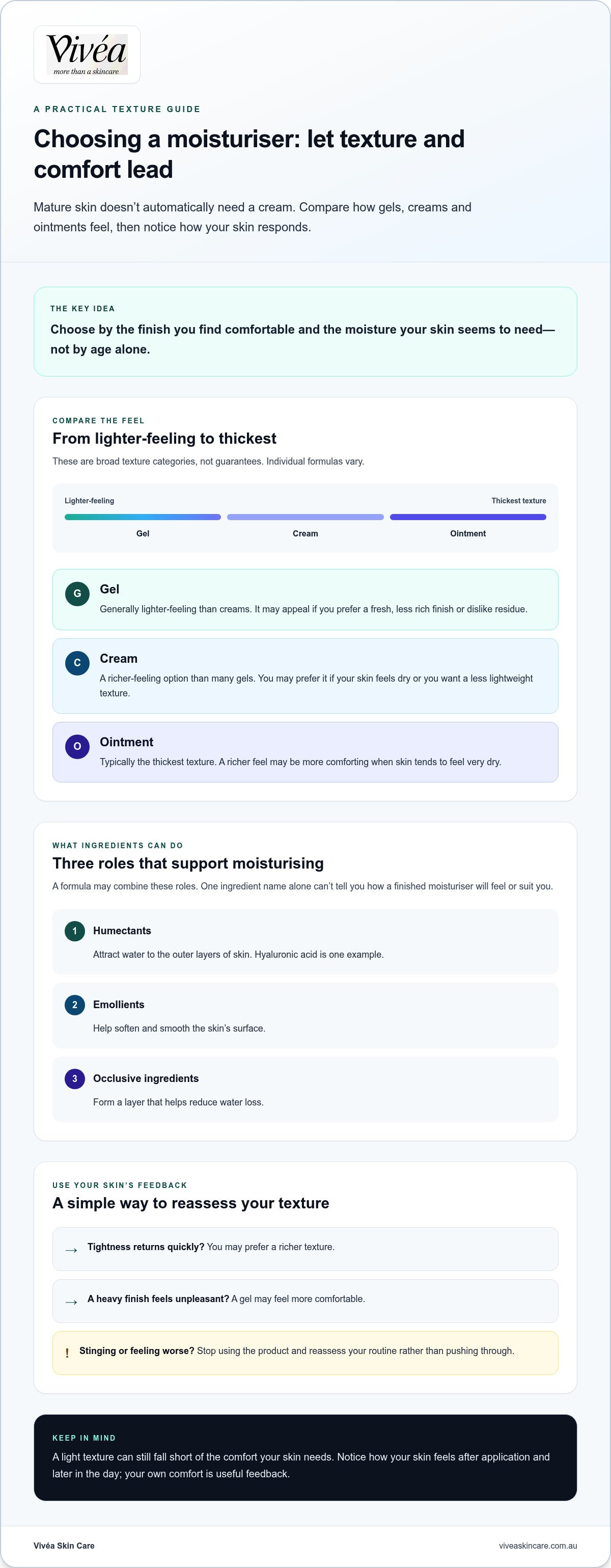
The American Academy of Dermatology describes gels as generally lighter-feeling than creams, with ointments typically the thickest texture. These are broad sensory categories, not guarantees about how every formula will feel. A gel might suit you if you prefer a fresh, less rich finish; a cream or ointment may feel more comforting if your skin tends to feel very dry. Individual formulas vary.
How ingredients contribute to a moisturiser’s role
Ingredient labels can offer clues, but they don’t tell the whole story. Humectants, such as hyaluronic acid, attract water. Emollients help soften and smooth the skin’s surface, while occlusive ingredients form a layer that helps reduce water loss. A product may combine these roles, and the overall formula, how you use it and your own comfort all matter.
Niacinamide is another ingredient you may see on a label. Its presence alone doesn’t establish how a particular moisturiser will feel or work for you. Look at the full ingredient list and consider your own sensitivities, rather than choosing on the strength of one familiar name.
Texture and suitability are related, but they aren’t the same: a moisturiser can feel light on application yet still not provide the comfort your skin needs. Notice how your skin feels after applying it and later in the day. If tightness returns quickly, you may prefer a richer texture; if a heavy finish feels unpleasant, a gel may be more comfortable. Either response is useful feedback about your preference.
Hormonal changes during perimenopause and menopause can coincide with changes in skin comfort, though experiences differ. Northwestern Medicine’s overview of menopause and skin changes discusses possible effects such as dryness. This context can help explain why your usual texture preference may shift, without making age or life stage the sole guide.
If a lightweight cooling feel appeals, explore Vivéa Skin Care’s menopause-focused skincare, developed in New Zealand to help women feel understood, supported and confident during this powerful stage of life. The range features moisturising, barrier-supporting products with low-allergen scent and mood-balancing fragrances.
Gel or cream moisturiser: how to choose for mature skin
Mature skin doesn’t automatically need a cream. A gel may feel more comfortable if you dislike a rich finish, while a cream or ointment may feel more reassuring if your skin often feels tight. Think of these textures as options, not age-based rules. Your skin’s day-to-day feel, your routine and the conditions around you can all influence what you enjoy using.
The right moisturiser texture depends on how your skin feels and what you find comfortable, not your age alone. Use this comparison as a starting point, then notice how a formula feels after application and through the day.
| Texture | Typical feel | May suit your preference if… | Consider |
|---|---|---|---|
| Gel | Often light and fresh | You prefer a less rich layer or dislike a heavier finish | A light feel may not be enough for your comfort; formulas vary |
| Cream | Usually richer than a gel | You want a more substantial, softening feel | It may feel too rich if you prefer skincare that feels barely there |
| Ointment | Thick and protective-feeling | You prefer a very rich texture on areas that feel especially dry | It can feel heavier than a gel or cream in a daily routine |
When might a lightweight gel feel like a good fit?
A gel could suit you if you prefer a fresh, lightweight layer, or if richer products leave a finish you find uncomfortable. You might enjoy that feel in a warm room, during a warmer part of the year, or under other daytime skincare. These are personal preferences, not promises that a gel will resolve ongoing dryness or a skin concern.
When might a richer texture feel more comfortable?
If tightness tends to return or your skin feels more comfortable with a cushiony finish, a cream may be worth trying. Some people prefer a richer texture at night or during cooler, drier weather, then choose a lighter option at other times. An ointment may feel too heavy for some faces, so let comfort guide your choice.
Skin preferences can shift with the seasons, indoor heating or air conditioning, and the other products in your routine. For example, you may reach for a gel on a warm morning but prefer a cream when your skin feels tight later in the year. You don’t need to settle on one texture forever, and a change in preference doesn’t mean your previous choice was wrong.
If you’re considering a hydrating gel moisturiser for mature skin, judge it by more than its age-related label or light feel. Notice whether you enjoy applying it and whether your skin feels comfortable afterwards. If it doesn’t feel sufficient, trying a creamier texture is a reasonable adjustment. The best fit is one that feels pleasant to use and suits your skin’s needs.
How to use a gel moisturiser in a simple mature-skin routine
A simple routine can make it easier to notice whether a moisturiser feels comfortable. Keep the steps distinct: cleanse gently, apply moisturiser, then use daytime sun protection as its own step. You don’t need to add several new products at once. Introducing one change at a time makes it easier to observe how your skin responds.
A gentle morning and evening approach
In the morning, cleanse gently if that suits your skin, apply your moisturiser according to its directions, then use a separate sunscreen product as directed. Moisturiser and sunscreen have different roles: a moisturiser supports everyday hydration and comfort, while sunscreen is the sun-protection step. Don’t assume a moisturiser replaces sunscreen unless its label specifically identifies it as a sunscreen.
In the evening, cleanse to remove the day’s products and apply moisturiser, following the product directions. Keep the routine familiar while you’re getting to know a new gel. If you already use other skincare, avoid changing several steps at once so you can more clearly identify what feels comfortable.
- Cleanse gently, using a cleanser that feels comfortable for your skin.
- Apply your moisturiser as directed on its packaging.
- In the morning, apply a separate sunscreen product according to its directions.
How to notice whether a moisturiser suits you
After introducing a product, notice how your skin feels after application and later in the day. Does it feel comfortable, or does tightness return? Do you notice irritation, such as stinging or redness? These observations can help you decide whether to continue, adjust your routine or stop using the product. Follow its directions, and discontinue use if irritation occurs.
There’s no need to judge a hydrating gel moisturiser for mature skin by texture alone. A light feel may be pleasant, but comfort through your usual routine matters too. If you notice visible dryness or tightness, that can guide a thoughtful change, such as choosing a different texture. It doesn’t promise a particular result, and a moisturiser may not address every reason skin feels uncomfortable.
Try to keep other routine steps steady while you observe. For instance, if you start a new moisturiser and a new cleanser at the same time, it may be harder to tell which one coincides with a change in comfort. Make adjustments calmly, one product at a time, and follow each product’s directions rather than assuming every formula should be applied in the same way.
If irritation continues after you stop using a product, or you have persistent skin concerns, seek professional advice. Skincare is for everyday cosmetic support, not a substitute for assessment of ongoing symptoms. For a lightweight cooling option within a menopause-specific skincare range developed in New Zealand, explore Vivéa Skin Care moisturisers.
Choosing a menopause-specific gel moisturiser from Vivéa Skin Care
Once you’ve considered which textures feel comfortable and how a moisturiser fits into your routine, compare those preferences with the product’s format. Vivéa® Cooling Day Gel‑Cream is a lightweight cooling gel-cream. Its texture may appeal if you prefer a lighter-feeling moisturiser, though your own experience is the best guide to whether it suits your routine.
How the Vivéa® Cooling Day Gel‑Cream fits the texture discussion
A gel-cream has a lightweight cooling feel, which may interest readers who prefer a less rich texture. Vivéa® Cooling Day Gel‑Cream is part of Vivéa Skin Care’s menopause-specific range. Its cosmetic skincare role is to moisturise and support the skin barrier; it doesn’t treat menopause or change hormones. Its format is one point to consider alongside your texture preferences, not a promise that it will suit everyone or resolve persistent dryness or irritation.
The range combines lightweight cooling gel-creams with low-allergen scent and mood-balancing fragrances. Vivéa Skin Care describes its products as clinically tested and dermatologically approved for safety and efficacy. If a lighter-feeling moisturiser appeals to you, consider the product’s stated features alongside your own comfort and sensitivities.
A considered next step for changing skin needs
Review the product information and directions to understand its intended use. Consider whether the lightweight cooling gel-cream format matches textures you already enjoy. If you’re sensitive to particular ingredients, read the ingredient information with your own sensitivities in mind. A product’s stated features can inform your choice, but they can’t predict exactly how it will feel on your skin.
If you decide to try it, introduce it as one new step at a time and follow its directions. Notice whether your skin feels comfortable during your routine, and discontinue use if irritation occurs. This measured approach leaves room to adjust without expecting a moisturiser to address every skin concern.
If this texture sounds like a possible fit, explore Vivéa® Cooling Day Gel‑Cream and review its product information before deciding. A considered choice begins with what feels right for you.
Choose a texture that feels right for your next step
Your routine can change as your preferences do. Let comfort guide your next choice, and give yourself room to adjust if your skin or daily habits shift. A hydrating gel moisturiser for mature skin may be worth considering if you prefer a lighter feel, but your own experience is the best guide.
Rather than expecting one product to suit every situation, notice what feels comfortable and make changes gradually. Small, considered choices can help you build a routine that feels manageable and personal.
Explore Vivéa Skin Care online to see the menopause-specific skincare range and find a texture that feels right for your routine.
Frequently Asked Questions
Can I apply a gel moisturiser under sunscreen?
Yes, apply your moisturiser first and use sunscreen as the final skincare step in the morning. Let the moisturiser settle before applying sunscreen; this may help reduce pilling when you spread the next layer. Use sunscreen according to its label, including any reapplication directions. Applying moisturiser underneath doesn’t extend the sunscreen’s protection, so don’t rely on it to change how often sunscreen needs to be reapplied.
How should I patch test a new gel moisturiser?
Follow the product’s patch-test directions if provided. Otherwise, try a small amount on a discreet area of skin rather than starting with your whole face, and observe how the area responds. Don’t patch test over broken or already irritated skin. A home test can’t rule out every reaction, so remain attentive when you begin using the product more broadly, particularly if you’ve reacted to skincare before.
What should I do if a moisturiser stings my skin?
Stop using it if it stings, and note when the sensation began, where it occurred and what other products you used around the same time. This information may help you identify a pattern if you seek advice. Avoid experimenting with several new products while your skin settles, as that can make it harder to work out what coincided with the discomfort. Don’t deliberately reapply a product to test the reaction.
Is fragrance always unsuitable for sensitive mature skin?
No, fragrance isn’t automatically unsuitable, but people’s responses differ. If scented skincare has bothered you before, check the ingredient information and consider choosing an option that aligns with your preferences. “Low-allergen” doesn’t mean fragrance-free or guarantee that a product won’t trigger a reaction. Consider a hydrating gel moisturiser for mature skin as a complete formula, not by one fragrance-related description alone.
Can I use a gel moisturiser with facial oil?
Yes, if both products are intended for facial use and the combination feels comfortable. Try them separately at first, then add the oil as a distinct step, following its label. If the layers pill or feel too heavy, use less product or keep the oil for another routine. There’s no need to add facial oil simply because a gel moisturiser has a lighter texture.
When should I seek professional advice about dry or irritated skin?
Seek professional advice if symptoms persist, keep returning, spread or interfere with sleep or everyday activities. Cracked skin, bleeding, marked swelling or signs of infection also warrant prompt assessment. A qualified health professional can help assess what may be contributing to the problem and advise on appropriate care. Bring along the product packaging or ingredient list, and note when the symptoms began and what skincare you’ve used.


