

Choosing an intimate balm for perimenopause starts with knowing where it is intended to be used. During perimenopause, hormonal changes can contribute to intimate dryness or sensitivity, making comfort feel less predictable. A product’s name alone does not tell you whether it is for external skin, internal use or a particular kind of comfort.
Depending on its formulation and directions, a balm may provide a moisturising or lubricating feel. It does not address the hormonal changes behind dryness or replace medical care. A vaginal moisturiser is generally intended to support moisture, while a lubricant is used to reduce friction during sexual activity. Always follow the product’s stated purpose and directions.
This guide explains common changes to intimate comfort during perimenopause, what an intimate balm may offer and how to assess product information. It also covers how to introduce a product thoughtfully and when to seek advice from a health professional.
Key Takeaways
- Intimate comfort can change during perimenopause. Knowing the difference between the vulva and the vagina helps you choose care for the right area.
- An intimate balm may offer a moisturising or lubricating feel, depending on its formula and directions.
- Review a product’s purpose, application area, directions and ingredients before use.
- Natural ingredients can still be unsuitable for some people, so take your own sensitivities into account.
- Vivéa® Natural Lubricant Balm is part of the Vivéa Skin Care range. Read its product information and directions before use.
Intimate Balm for Perimenopause: What Changes and Where?
Perimenopause can coincide with changes in intimate comfort, including dryness, sensitivity or discomfort. Shifts in oestrogen may affect moisture and the tissues of the vulva and vagina, but experiences vary. Some people notice changes, while others do not. Dryness can also have other causes, so the sensation alone cannot identify what is behind it.
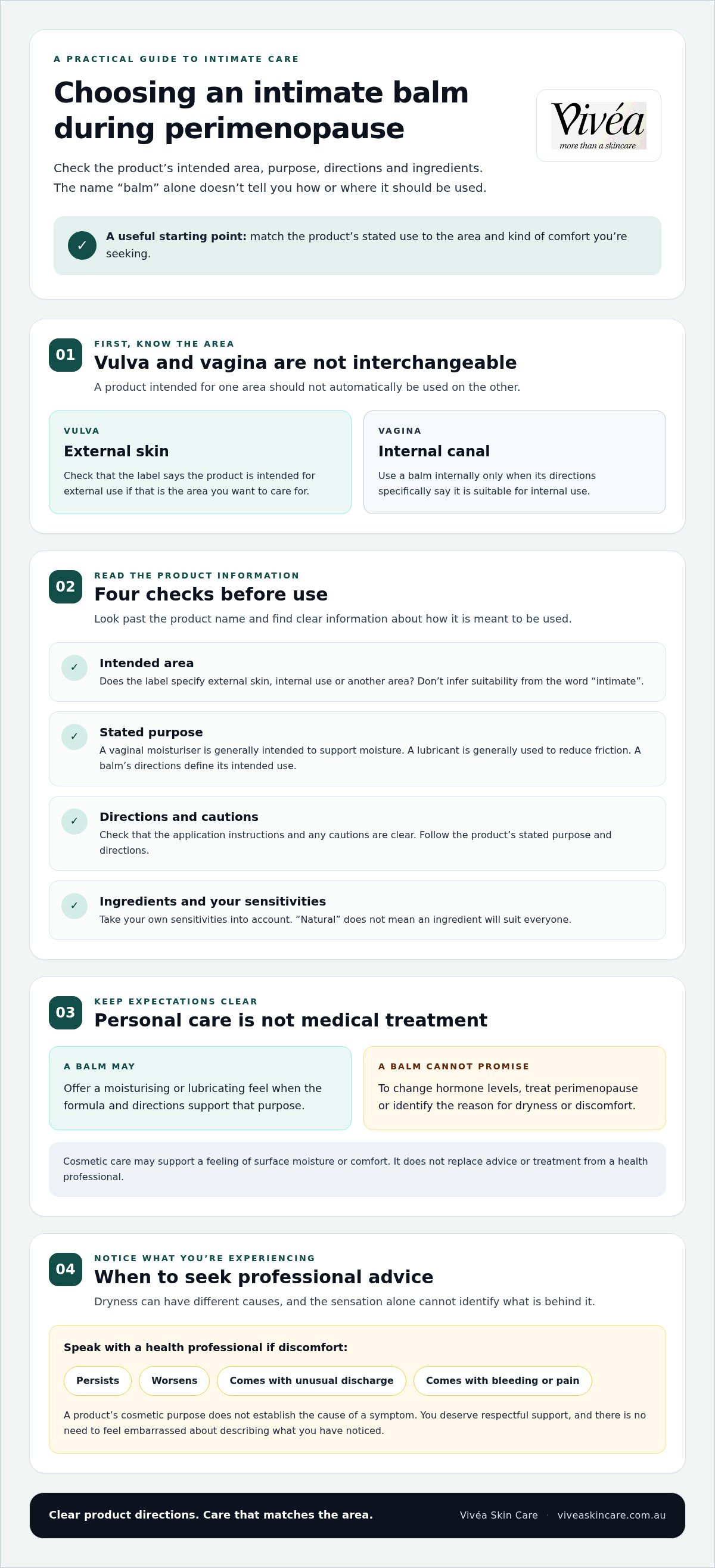
It helps to be clear about the area involved. The vulva is the external genital skin; the vagina is the internal canal. They are connected, but they are not interchangeable terms. A product intended for one area should not automatically be used on the other.
What do people mean by intimate dryness?
“Intimate dryness” is a broad term for sensations such as tightness, reduced natural moisture, tenderness, irritation or discomfort. The feeling may be on the vulval skin, inside the vagina, or in both places. Some people mainly notice friction during intimacy; others feel dry or sensitive during everyday activities. The location and pattern can help you describe what you are experiencing, but do not confirm the cause.
Hormonal changes during perimenopause may contribute to reduced moisture or tissue sensitivity. An overview of perimenopause and its possible symptoms offers further context, while the NHS outlines other possible causes of vaginal dryness, including some medicines and health conditions. Irritation from fragranced products or washing may also affect comfort. Similar sensations can have different explanations, so avoid self-diagnosing based on dryness alone.
Why location matters when choosing intimate care
Read the product directions before use. They should state the intended application area and explain how to apply the product. The word “intimate” or the format “balm” does not establish whether something is intended for external skin, internal use or both. Use a balm internally only if its directions specifically say it is suitable for that purpose.
The vulva is external skin and the vagina is an internal canal. Match the product’s stated use to the area you want to care for.
This distinction matters when choosing an intimate balm for perimenopause. A product for external vulval skin may not be suitable for vaginal symptoms. A cosmetic product that adds surface moisture or lubrication also does not address hormonal changes or identify why discomfort is happening. Choose according to the stated purpose, not just the general feeling of dryness.
If discomfort persists or worsens, or comes with unusual discharge, bleeding or pain, seek advice from a health professional. NHS guidance explains when to seek help for unusual vaginal discharge and vaginal bleeding between periods or after sex. You deserve clear, respectful support, and there is no need to feel embarrassed about describing what you have noticed.
What Can an Intimate Balm Do During Perimenopause?
An intimate balm may offer a moisturising or lubricating feel when its directions support that purpose and specify the area of use. “Balm” describes a product format, not a guaranteed result. Its role is personal care, not changing hormone levels or addressing the underlying reason for dryness.
Perimenopause can involve hormonal changes that affect intimate comfort, but cosmetic care is distinct from medical care. For broader, evidence-informed information about menopause and perimenopause, The Menopause Society offers resources for the public and health professionals. A balm may be one personal-care option, but it cannot determine what is causing a symptom.
Balm, moisturiser and lubricant: what do the terms suggest?
These words can offer clues about a product’s form or purpose, but they do not establish exactly how or where it should be used. A moisturiser is generally intended to add or maintain moisture, while a lubricant is generally intended to reduce friction. “Balm” often describes a richer topical format, but the product’s directions define its intended use.
Before choosing, look beyond the name and check:
- Intended area: Does the label specify external skin, internal use or another area?
- Purpose: Does the product information describe moisturising, lubrication or another cosmetic function?
- Directions: Are the application instructions and any cautions clear?
This helps avoid assuming that products in different categories can be used in the same way. If the directions do not support the use you have in mind, do not infer it from words such as “intimate” or “natural”.
What an intimate balm cannot promise
An intimate balm should not be presented as treating perimenopause, changing hormones or resolving a diagnosed condition. Cosmetic care may contribute to a feeling of moisture or comfort, but it does not replace advice or treatment from a health professional, including discussion of options such as HRT where appropriate.
Ingredient research also needs careful interpretation. A study about one ingredient does not prove that a finished product will have the same effect. Formulation, concentration and how a product is used all matter. Product-specific claims should be supported by evidence about that product, not inferred from research on a single ingredient.
Cosmetic care may support surface comfort; medical treatment addresses health conditions and hormonal changes.
If you are considering an intimate balm for perimenopause, use product information to see whether its stated purpose fits your needs. You can explore intimate-care products from Vivéa Skin Care, while discussing persistent or concerning symptoms with a health professional.
How to Assess an Intimate Balm for Perimenopause
Start with the product label rather than assumptions based on words such as “natural”, “gentle” or “intimate”. Check the stated purpose, application area, full directions and ingredient list. These details help you decide whether a balm matches the kind of comfort you are seeking and whether it contains anything you already know does not suit you.
Which label details deserve attention?
Look for clear directions stating whether the product is for external use, internal use or both. If the label does not specify the area, do not assume. Read the full ingredient list and consider any personal sensitivities or past reactions. This checklist can help:
- Intended use: Is the balm described for the area where you plan to apply it?
- Directions and cautions: Are the method of use and any restrictions explained clearly?
- Ingredients: Can you review the complete list and identify ingredients you have previously found unsuitable?
- Compatibility: Does the product information specifically address use with condoms or other products you rely on?
Do not infer condom compatibility, or compatibility with a prescribed treatment, from a product’s name or ingredients. Follow product-specific directions and relevant instructions for anything used alongside it. If compatibility is not addressed, avoid making assumptions about combined use.
How should sensitivity guide your choice?
Sensitive skin can respond differently to different formulas. “Natural” does not mean suitable for everyone, and claims such as fragrance-free or cooling cannot guarantee that a product will feel comfortable for you. These terms describe product features, not universal tolerance. Do not assume that all intimate balms share the same ingredients, testing or safety profile.
Consider what you already know about your skin. If a particular ingredient has caused irritation before, check the list rather than relying on broad marketing language. Follow the label, and stop using the product if you notice irritation or discomfort. Do not push through a reaction in the hope that your skin will adjust.
Product information can guide a considered choice, but it cannot establish the cause of intimate symptoms. If discomfort is persistent, unusual or worsening, seek advice from a health professional. This is especially important if you are unsure whether a symptom is related to a product, a sensitivity or another concern.
In short, assess an intimate balm for perimenopause by matching its stated use to the area and purpose, reviewing the directions and ingredients, and taking your own sensitivities seriously. A clear label supports an informed choice, but cannot promise that every formula will suit every person.
How to Introduce Intimate Balm Gently and Thoughtfully
Start with the product’s own directions, not a routine borrowed from another balm. Formulas and intended uses differ, so do not guess the application area, amount or frequency. Read the label and follow its instructions.
A label-led approach to trying a balm
Before use, confirm that the product is intended for the area you have in mind, then read all directions and cautions. Follow the stated amount and frequency rather than applying more or using it more often in the hope of extra comfort. If the instructions are unclear, pause rather than improvising.
- Read the full directions. Confirm the intended application area, amount, method of use and frequency. Do not assume a balm is for internal use unless its instructions specifically say so.
- Review the ingredients and cautions. Consider known personal sensitivities and any warnings on the label. “Natural” or “gentle” alone cannot predict how your skin will respond.
- Keep other intimate care simple. While assessing how the balm feels, avoid introducing several new products at once. A simpler routine can make it easier to notice changes.
- Pay attention to your comfort. Stop using the product if discomfort or irritation develops. A reaction does not identify its cause, so do not try to diagnose it or push through it.
Do not add a schedule or application method that is not on the label. Patch testing, daily use and a particular amount may not suit every intimate product. Follow the directions for the specific balm and take an unhurried approach.
When self-care may not be enough
Cosmetic care may be part of an everyday routine, but it is not a substitute for health advice. Speak with a health professional if symptoms persist, feel unusual for you or worsen, or if you are unsure what may be causing them. You do not need to work out the cause on your own.
Seeking advice and choosing gentle cosmetic skincare can go together. A health professional can help assess symptoms while you make considered choices about products and follow their directions. If symptoms raise concern, prioritise appropriate advice rather than repeatedly changing products to find relief.
For a label-led next step, explore Vivéa® Natural Lubricant Balm and read its product information and directions before deciding whether it fits your intimate-care routine.
Vivéa® Natural Lubricant Balm: A Thoughtful Next Step
After learning how to assess intimate-care products, you may be considering a balm as part of your approach to changing comfort. Vivéa® Natural Lubricant Balm is part of the Vivéa Skin Care range. Its name identifies it as a lubricant balm, while its product information and directions explain how it is intended to be used.
How the balm fits the intimate-care question
If you are exploring an intimate balm for perimenopause, begin by matching your concern with the product information. Check the stated purpose and application area, then follow the directions as written. Do not infer that a balm is intended for internal use, compatible with condoms or suitable alongside another treatment unless the product information explicitly supports that use.
Keep the distinction between personal care and medical treatment clear. A cosmetic product may be considered as part of an intimate-care routine, but it does not treat perimenopause, alter hormone levels or identify the cause of ongoing symptoms. If discomfort persists or concerns you, professional health advice remains important. Choosing gentle skincare and seeking advice can sit comfortably alongside one another.
Product details matter more than broad assumptions. The word “natural” does not tell you how a formula will suit your skin, and a product name cannot replace directions. Take time to read the information and decide whether the stated use fits what you are looking for.
A supportive approach from Vivéa Skin Care
Vivéa Skin Care is a menopause-specific skincare brand developed and created in New Zealand. Its mission is to help women feel understood, supported and confident during this powerful stage of life. That supportive approach recognises that intimate comfort can change, while respecting that every person’s experience is different.
Vivéa Skin Care’s range combines low-allergen scent with mood-balancing fragrances. Those range-wide descriptors should not be taken as product-specific claims about Vivéa® Natural Lubricant Balm. For the balm, use its own product information to understand its stated purpose and directions.
Reading the product details is a practical next step. It helps you understand how the balm is intended to be used and whether that fits your intimate-care preferences. Explore Vivéa® Natural Lubricant Balm and read its product information before use.
Choose a Gentle Next Step for Intimate Comfort
Let your intimate-care routine be guided by what feels comfortable, clear product directions and the support you need. If you are considering an intimate balm for perimenopause, take your time with the product information and choose according to its stated use. Vivéa Skin Care’s New Zealand-developed, menopause-specific approach centres on helping women feel understood, supported and confident.
Vivéa® Natural Lubricant Balm is part of the Vivéa Skin Care range. Explore its product information at your own pace, and keep professional health advice in the picture if symptoms persist or concern you.
Explore Vivéa® Natural Lubricant Balm as a considered next step in your intimate-care routine. You deserve care that feels informed and right for you.
Frequently Asked Questions
Can you use an intimate balm internally during perimenopause?
Only use an intimate balm internally if its own directions explicitly say it is suitable for internal application. A balm intended for external vulval skin should not be placed in the vaginal canal. Read the product instructions and cautions rather than relying on words such as “intimate” or “natural”. If the directions do not clearly explain where it can be used, avoid internal application and seek advice from a health professional.
Is an intimate balm the same as a vaginal moisturiser or lubricant?
No. These terms can refer to different product formats or purposes. A vaginal moisturiser is generally intended to support moisture over time, while a lubricant is generally used to reduce friction during sexual activity. “Balm” describes a format, but its use depends on its specific directions. When choosing an intimate balm for perimenopause, check that its stated purpose and application area match your needs.
How often should you apply an intimate balm?
Follow the frequency stated in the balm’s directions. There is no schedule that applies to every product. Do not exceed the instructions, as applying more often does not guarantee greater comfort. If directions are unclear, pause rather than creating your own routine, and seek guidance from a health professional or pharmacist.
Can an intimate balm cause irritation on sensitive skin?
Yes, a product can cause irritation or discomfort for some people, including those with sensitive skin. A “natural” or “gentle” description cannot guarantee that a formula will suit everyone. Review the ingredients for anything you have reacted to before, follow the directions and stop use if irritation develops. If discomfort continues after stopping, or you are unsure what to do next, speak with a health professional.
Can you use an intimate balm with condoms or other intimate products?
Do not assume an intimate balm is compatible with condoms, medicines or other intimate products. Compatibility can depend on the specific formula and the item used alongside it. Look for product-specific guidance on the balm’s label and follow the condom or treatment instructions too. If compatibility is not addressed, avoid combining products until you have received appropriate advice from a pharmacist or health professional.
When should intimate dryness be discussed with a healthcare professional?
Discuss intimate dryness with a health professional if it persists, worsens or affects your usual activities. Seek advice if you notice unusual discharge or bleeding too. Healthdirect’s guidance on vaginal discharge explains when it may need medical attention. These symptoms do not identify a cause by themselves, so avoid trying to diagnose them or relying on a cosmetic product alone. You can still choose gentle skincare while getting advice about symptoms that concern you.


