

“Natural” doesn’t guarantee comfort, and a richer texture isn’t automatically the better choice. When comparing a natural intimate moisturiser in Australia, start with what you want the product to do, then check its intended use, directions and ingredients. Texture can help you choose between options, but it can’t tell you whether a product is a moisturiser or a lubricant.
In general, moisturisers are used for ongoing intimate dryness, while lubricants are used around sexual activity to reduce friction. A balm may feel richer and a gel may feel lighter, although formulas vary. Check the product label rather than relying on the format or name.
This guide compares balm and gel formats, explains what an intimate moisturiser may support and what it can’t do, and offers practical steps for choosing based on personal comfort. You’ll also learn why “natural” doesn’t automatically mean gentle or suitable for everyone, and when persistent or concerning symptoms are a reason to speak with a health professional.
Key Takeaways
- Balm and gel formats differ in feel, but the right choice depends on your preferences and the product’s stated purpose.
- When comparing a natural intimate moisturiser in Australia, look beyond the word “natural” and read the ingredients, directions and cautions.
- Check whether a product is labelled for everyday moisturising or as a lubricant, then use it only as directed.
- Use a simple decision path: clarify what you’re seeking, consider texture, check intended use and read the label.
- Vivéa® Natural Lubricant Balm is one product to consider if you’re looking for a lubricant balm.
Natural intimate moisturiser in Australia: what are you comparing?
Balm and gel products can differ in feel and formulation. A balm may feel richer on application, while a gel may feel lighter, but texture alone doesn’t tell you whether a product is intended for external vulval skin, internal vaginal use or lubrication during sex. Start with the product’s stated purpose and directions.
Intimate dryness can be uncomfortable and may accompany changes during perimenopause and menopause. It isn’t a personal failing, and it doesn’t affect everyone in the same way. When comparing a natural intimate moisturiser in Australia, look beyond the word “natural”: it doesn’t explain how a product should be used or whether it will suit you.
What does an intimate moisturiser do?
An intimate moisturiser is intended to add or help retain moisture in the specific intimate area named on its label. Some products are made for external vulval skin; others may be intended for internal vaginal use. The vulva is the external genital area, while the vagina is the internal muscular canal. Don’t assume that a product made for one area is suitable for the other. Follow its directions.
A lubricant has a different stated purpose: it is used to reduce friction, commonly during sexual activity. A moisturiser and a lubricant aren’t interchangeable just because both relate to intimate comfort. Some products may have more than one intended use, but the label should make that clear. For general information about vaginal dryness and possible causes, see Healthdirect’s guide to vaginal dryness.
Why intimate comfort can change during perimenopause and menopause
Oestrogen levels change around menopause, and some people notice changes in vaginal or vulval comfort, including dryness. The Australian Menopause Society describes these as possible genitourinary changes associated with menopause. Experiences vary, and dryness can have other causes. This context may help explain a change, but it can’t identify its cause for an individual.
For a gentle, everyday-focused discussion of intimate comfort during this transition, Vivéa Skin Care also covers the topic in Intimate Balm for Perimenopause: Gentle Everyday Comfort.
When comparing products, check the named area of use, intended purpose, directions, ingredients and cautions. “Natural” doesn’t guarantee that every ingredient will suit every person or sensitive area. If a product causes discomfort, stop using it. If symptoms persist, worsen or concern you, speak with a health professional. This keeps everyday product choice separate from advice about ongoing symptoms.
Balm vs gel: how texture and intended use shape the choice
A balm or gel can feel different on application, but the format alone can’t tell you how well a product will suit your needs. Formulas vary: a balm isn’t automatically more moisturising than a gel, and a gel isn’t necessarily lighter or more suitable for sensitive skin. Consider your comfort preferences alongside the product’s stated purpose.
| What to compare | Balm | Gel |
|---|---|---|
| Texture | Often described as a balm, but the actual feel depends on its formulation. | Often described as a gel; consistency and finish still vary between formulas. |
| Preferred feel | Consider whether you enjoy a balm-like texture and how it feels on the labelled area. | Consider whether you prefer a gel-like texture and how it spreads or feels after application. |
| Label wording | Look for the stated purpose, such as lubricant or moisturiser, rather than relying on “balm”. | Check the product’s stated purpose; “gel” describes a format, not necessarily its use. |
| Intended use | Follow the directions for the specific product and area named on its label. | Follow the directions for the specific product and area named on its label. |
This table describes common format language, not how every product performs. Ingredients and formulation influence a product’s feel and function, so compare the full label rather than judging by “balm” or “gel” alone. A product labelled as a lubricant shouldn’t automatically be treated as an everyday moisturiser, or vice versa.
When a balm texture may suit your preferences
A balm may appeal if you enjoy a balm-style consistency, but the format doesn’t guarantee longer-lasting comfort. Consider the sensation you prefer, then check whether the product is intended for the area and purpose you have in mind. Vivéa® Natural Lubricant Balm is identified as a lubricant balm. Its product information and directions explain its stated use.
When a gel texture may suit your preferences
A gel may suit someone who prefers a gel-style consistency, but “gel” alone doesn’t establish how easily a formula spreads, the finish it leaves or where it can be used. These qualities vary by product. Read the directions and cautions, and use it only for the stated purpose and area. If you’re comparing a natural intimate moisturiser in Australia, let your comfort and the label guide your decision.
Texture can help narrow your options, but it can’t replace checking intended use. To explore the balm named above, view Vivéa® Natural Lubricant Balm.
Natural intimate moisturiser claims: what to compare beyond texture
A considered choice depends on more than whether a product is called a balm or gel. Read the label for four essentials: the ingredients, stated purpose, intended area of use, and directions or cautions. These details offer more practical guidance than broad words such as “natural” or “gentle”, which don’t establish that a product will suit every person or sensitive area.
For anyone comparing natural intimate moisturisers, “natural” is a product claim, not a guarantee of personal suitability. People can respond differently to the same ingredient, and a natural origin doesn’t rule out irritation. Information about one ingredient also doesn’t prove how a finished formula will feel or perform. Consider the complete product rather than a single appealing claim.
How to read ingredient and suitability information
Start with the ingredient list and instructions on the product packaging. Check the named area of use and look for cautions relevant to your circumstances. If you have known sensitivities, compare the ingredients with those you already know you avoid. A short list or plant-derived ingredients don’t automatically mean a product will feel comfortable for you.
Research about an individual ingredient isn’t the same as evidence for a finished product, which may contain several ingredients in a particular formulation. Avoid relying on general ingredient articles to make product-specific promises. If the directions don’t answer a question about use, seek advice from a qualified health professional rather than guessing, especially for internal use.
Moisturiser or lubricant: how to tell what a product is for
Similar-looking products can have different purposes. Look for clear label wording that identifies whether a product is intended as a moisturiser, a lubricant or for another use, then follow the directions. Don’t assume a product is suitable for sexual use or compatible with condoms, toys or other materials unless its product-specific information says so. If compatibility matters, rely only on guidance for that exact product.
Cosmetic moisturising language may describe a product’s intended cosmetic role, such as moisturising or conditioning. It doesn’t mean the product treats the cause of dryness, a medical condition or a change in hormone levels. Be cautious of bold promises that go beyond comfort-focused wording and claim to cure, prevent or treat a health condition.
If a product causes irritation or discomfort, stop using it and seek advice if the reaction persists. Ongoing discomfort, worsening symptoms or unusual changes deserve attention from a qualified health professional, rather than repeated experimentation with products. A label can guide everyday product use, but it can’t diagnose what’s causing symptoms.
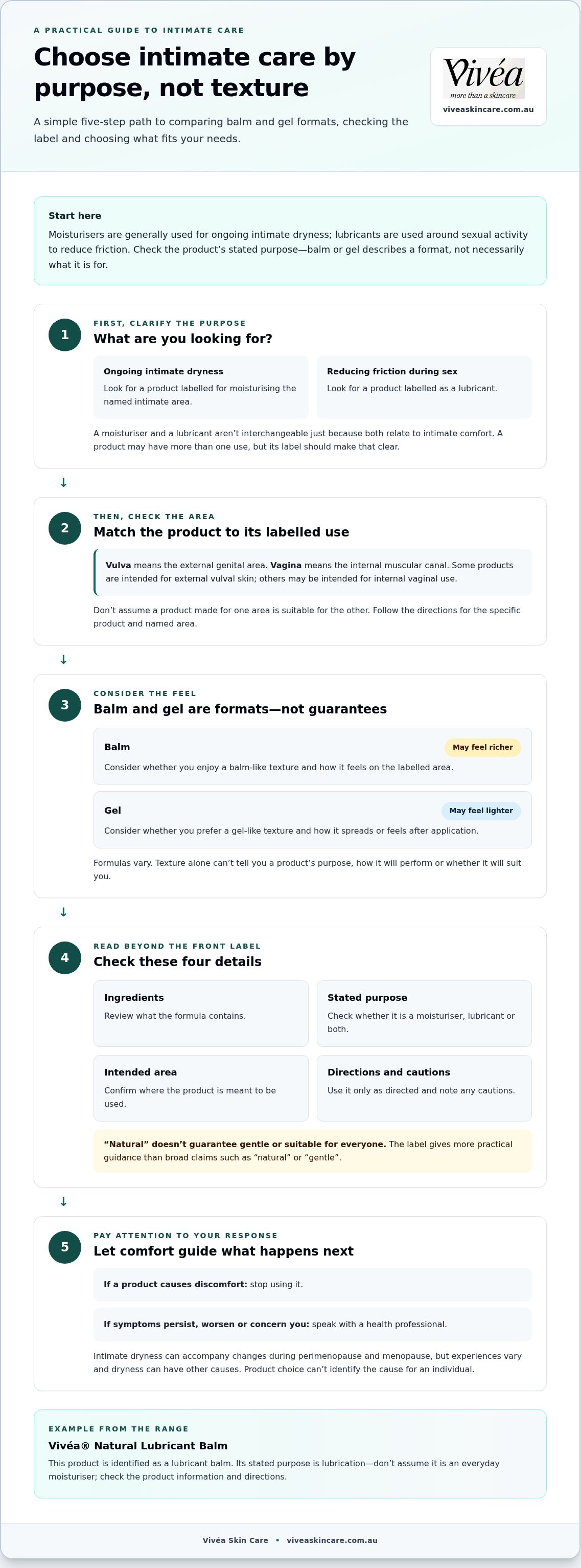
A practical checklist for choosing an intimate moisturiser
A simple decision path can make product labels easier to assess. Begin with the kind of comfort you’re seeking, then use the stated purpose and directions to narrow your options. Texture matters, but it shouldn’t be the only deciding factor.
- Clarify your need. Are you looking for a product for everyday moisturising comfort, or one labelled as a lubricant for use during sexual activity? The purposes can differ, so identify what you want before comparing formats.
- Compare the texture. Consider whether you prefer a balm-style or gel-style feel. Neither format is universally better, including for changes associated with perimenopause or menopause.
- Check the intended use. Look for the area the product is designed for and whether the label describes it as a moisturiser, lubricant or another type of product.
- Read the directions. Follow the product instructions and cautions. Don’t infer where or how to use a product from its texture or name alone.
In short, clarify your need, compare the texture, check the intended use and follow the directions. This four-part check helps you compare natural intimate moisturisers without relying on broad claims or assumptions.
Match the product format to your comfort preference
Think about the feel and application style you’d find comfortable, while keeping the product’s labelled purpose in view. A balm or gel is a format, not a promise about how it will feel for you. There’s no single texture that suits everyone, and a preferred format doesn’t establish that a product is suitable for a particular area.
Use the balm-versus-gel comparison above to weigh texture alongside intended use, rather than treating format as the deciding factor.
Know when skincare guidance is not enough
Product labels can guide everyday use, but persistent, worsening, painful or unusual symptoms deserve advice from a qualified health professional. This is especially important if discomfort continues after you stop using a product that seems to irritate the area. A moisturiser or lubricant shouldn’t replace professional guidance about ongoing symptoms.
If you’re ready to consider a balm format, explore Vivéa® Natural Lubricant Balm and use its product information to decide whether its stated purpose aligns with your needs.
Vivéa® Natural Lubricant Balm: a considered option to explore
Once you’ve considered texture, intended use and label information, assess a particular product on its own terms. Vivéa® Natural Lubricant Balm is part of Vivéa Skin Care’s menopause-specific skincare range, developed and created in New Zealand. Its name identifies it as a lubricant balm. Read the product information and directions to understand its stated use.
How the balm fits the comparison
“Balm” describes the product format, while “lubricant” identifies its stated category. Neither word alone confirms every detail of use or suitability for an individual. The same principle applies when comparing a natural intimate moisturiser: look beyond format and read the product information before deciding whether it fits your needs.
Vivéa Skin Care describes its range with the terms “low-allergen scent” and “mood-balancing fragrances”. These are range-level descriptors, not a reason to assume a particular ingredient, scent profile or individual response to this balm. Personal sensitivities vary, so consider the balm’s own ingredient information and cautions rather than relying on a broad category description.
Product information is also where to find the labelled area of use, directions and relevant cautions. Don’t infer compatibility, internal use or a particular performance from the product name or balm format. A lubricant isn’t automatically an everyday moisturiser or a treatment for dryness, menopause or a medical condition.
Explore the product at your own pace
Take time to read the product details, consider whether its stated purpose matches what you’re looking for, and compare that information with your comfort and texture preferences. If symptoms are ongoing or concerning, product selection shouldn’t take the place of qualified health advice.
Vivéa Skin Care also discusses intimate comfort during perimenopause in Intimate Balm for Perimenopause: Gentle Everyday Comfort. The article offers related context, while the balm’s product information provides details about the product itself.
If you’d like to consider it further, explore Vivéa® Natural Lubricant Balm and decide whether its stated purpose feels relevant to you.
Choose a next step that feels right for you
Intimate care is personal, and your preferences may shift over time. Give yourself room to notice what feels comfortable, without treating one texture or product type as the right answer for everyone. If you’re still weighing up natural intimate moisturiser options in Australia, let your needs guide the decision rather than choosing by a label alone.
Vivéa® Natural Lubricant Balm is one option to consider if you’re looking for a lubricant balm. Explore its product information and decide whether its stated purpose aligns with what you’re seeking. For ongoing or concerning symptoms, a qualified health professional can help you consider what may be contributing to them.
Explore Vivéa® Natural Lubricant Balm when you’re ready to learn more.
Frequently Asked Questions
What is the difference between an intimate moisturiser and a lubricant?
An intimate moisturiser is generally chosen for ongoing moisture-related comfort, while a lubricant is used to reduce friction during sexual activity. Their purposes can differ even if both products feel soothing or have a similar texture. If you’re looking for a product specifically for sex, check that its label identifies it as a lubricant and follow its directions rather than assuming any moisturiser will serve the same purpose.
Is a natural intimate moisturiser suitable for sensitive skin?
Not necessarily. “Natural” doesn’t guarantee that a product will suit sensitive skin, as people can react to naturally derived ingredients as well as other ingredients. Read the full ingredient list and cautions, and consider any sensitivities you already know about. If you’ve had reactions to intimate-care products before, a pharmacist or other qualified health professional can help you discuss what to avoid rather than guessing from marketing terms.
Can I use an intimate balm instead of a gel?
Choose a balm instead of a gel only if the balm’s stated purpose and directions match your intended use. A product labelled as a lubricant shouldn’t automatically be substituted for a product intended for ongoing moisturising. Texture doesn’t establish where a product can be used or how often. Check the specific label, and don’t use a product internally unless its instructions clearly say it’s intended for that use.
Can menopause cause intimate dryness?
Yes, intimate dryness can occur around menopause, although it doesn’t affect everyone and may have other causes. The Australian Menopause Society describes vaginal and vulval changes as possible experiences associated with menopause. If dryness is new, persistent or affecting your comfort, a health professional can help assess it and discuss appropriate options. You don’t need to choose a product before seeking advice about symptoms that concern you.
How often should I use an intimate moisturiser?
Follow the frequency stated on the product label, as there isn’t one schedule that applies to every formula or person. Don’t apply it more often than directed simply because discomfort continues. If the directions don’t explain how frequently to use it, seek guidance from a pharmacist or health professional. Ongoing symptoms are a reason to ask about possible causes rather than relying on repeated application alone.
Can an intimate moisturiser treat vaginal dryness?
An intimate moisturiser may be intended to provide moisture-related comfort, but that doesn’t mean it treats the underlying cause of vaginal dryness. Cosmetic products shouldn’t be relied on to diagnose or manage a medical condition. If dryness persists, is painful or comes with other unusual symptoms, speak with a qualified health professional. They can help determine whether further assessment or treatment options are appropriate for your circumstances.
What should I look for when buying an intimate moisturiser in Australia?
When comparing natural intimate moisturisers in Australia, check each product’s purpose, named area of use, ingredient list, directions and cautions. Look for clear wording that distinguishes moisturising from lubricating use, and don’t treat “natural” as proof of suitability. If you need compatibility with condoms or other materials, rely only on product-specific guidance. Choose based on your intended use, not texture or broad marketing claims alone.
To explore a lubricant balm from Vivéa Skin Care, view Vivéa® Natural Lubricant Balm and read its product information.


